
World Cup
Mexico’s World Cup 2026 campaign began with a measure of relief and emphatic clarity: a 2-0 victory over

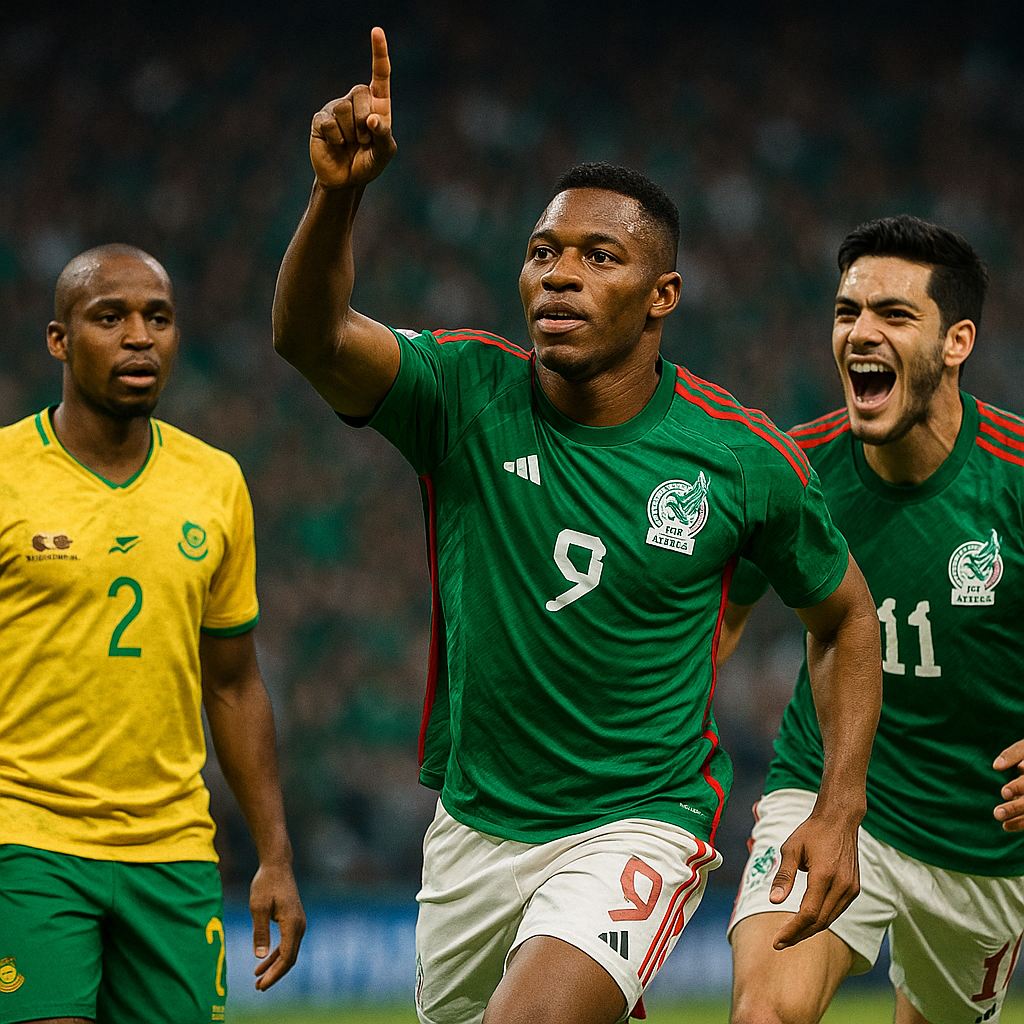
Mexico’s World Cup 2026 campaign began with a measure of relief and emphatic clarity: a 2-0 victory over South Africa at the Estadio Azteca, a stadium laden with history but also a burden given Mexico’s seven previous failures in opening matches on this stage. The breakthrough goal from Julián Quiñones in the 9th minute set the tone early, followed by a clinical finish from Raúl Jiménez, confirming Mexico’s tactical superiority but also highlighting South Africa’s disciplinary instability.
From a structural standpoint, Mexico dominated territorial possession and phase transitions with their familiar high-tempo, aggressive pressing style. They effectively controlled South Africa’s rhythm, cutting off easy access to midfield and exploiting flanks with width and forward runs. Quiñones’s early goal was emblematic of Mexico’s intent: rapid ball circulation immediately followed by incisive forward movement that South Africa struggled to contain.
South Africa’s tactical setup, ostensibly intended to absorb pressure and exploit counters, was compromised not only by execution but by discipline. Two crucial red cards—first Sphephelo Sithole’s intervention to halt a Mexican breakaway, then Themba Zwane’s dismissal after a VAR review for striking—reduced South Africa to nine men at various match points. This numerical deficit crippled their ability to maintain structural integrity and compact defensive lines, allowing Mexico to consolidate control without excessive exertion. César Montes’s own red card for Mexico momentarily disrupted Mexico’s defensive stability, but it was well managed and insufficient to shift momentum.
These disciplinary lapses reflect deeper issues in South Africa’s transition management and defensive cohesion. Stopping counterattacks with fouls rather than positional discipline highlights a reactive deficit that must be addressed to remain competitive in Group A. The red cards not only hindered South Africa in this match but impose a tactical limitation going forward, with key players suspended for the next fixture against the Czech Republic.
The standings set by this result give Mexico a three-point buffer and a +2 goal difference advantage—a valuable psychological and mathematical foothold in a balanced group that includes South Korea and Czech Republic. For Mexico, this win breaks a historical cycle of opener underperformance, marking a crucial confidence boost. South Africa, meanwhile, confronts mounting pressure to rectify both tactical discipline and defensive organization as they prepare for a must-win second match.
In this opening group test, Mexico demonstrated sharp tactical control despite a moment’s vulnerability from disciplinary disruption. South Africa’s performance, by contrast, crystallized the gulf between structural defensive resilience and costly indiscipline that South African football must refine if it is to advance beyond this stage.